
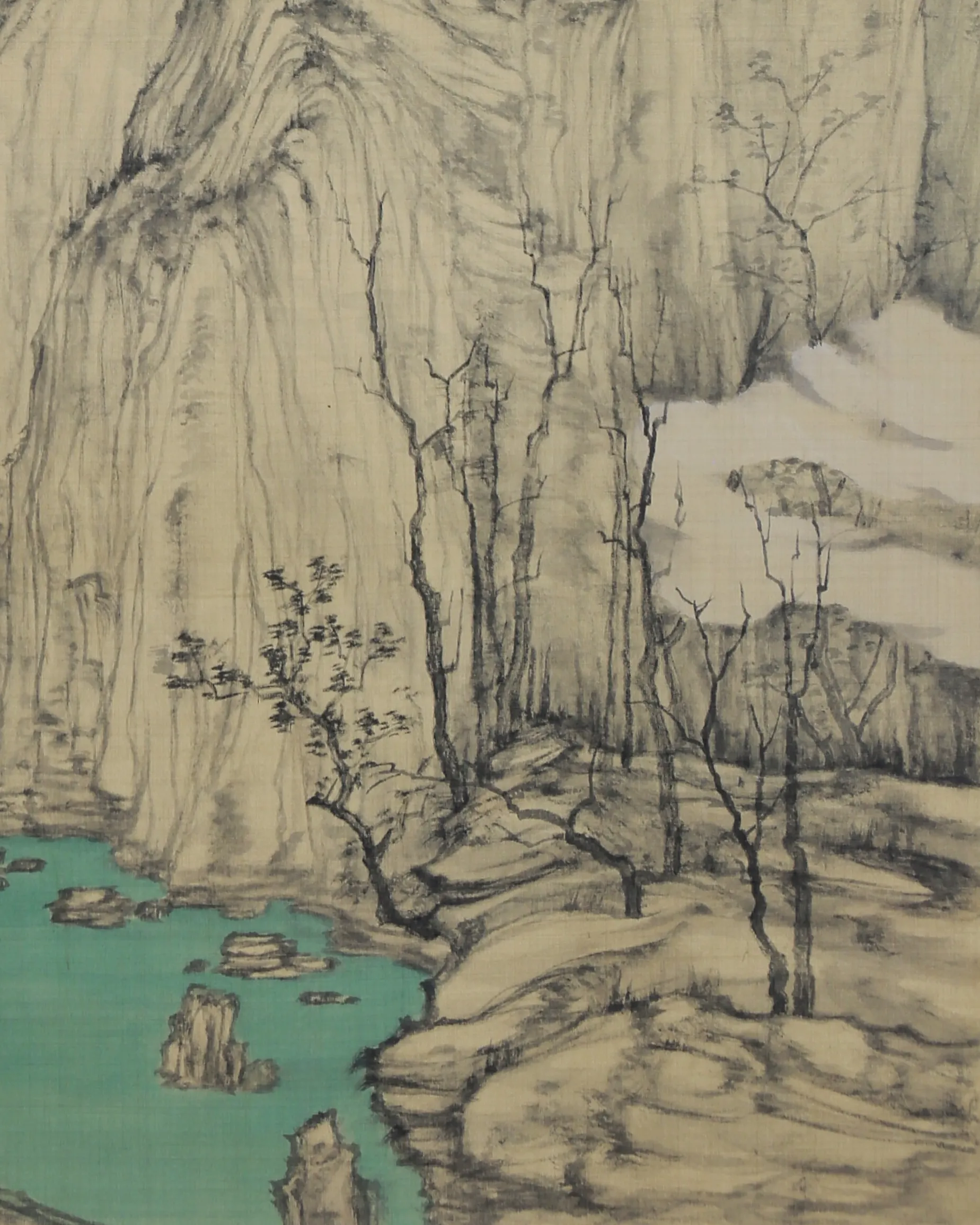
Chinese landscape painting has long been more than a representation of mountains, rivers, and trees. It is a way of contemplating the relationship between humanity and nature, expressing personal feeling, and exploring the inner life through the visible world. Within this tradition, landscapes become places of memory, solitude, and spiritual reflection.
The contemporary Chinese artist He Huibin (何慧斌) continues this poetic approach in his landscape paintings. Through expressive brushwork, subtle color, carefully composed scenery, and literary inscriptions, he brings together the visual and literary dimensions of Chinese art. Four paintings available through SailUp Arts—Silent Sitting (2014), Long River and Bright Moon (2016), Autumn Chill, Longing for Chang'an (2018), and Old Mountain in Autumn (2019)—offer a compelling opportunity to explore the enduring appeal of this artistic tradition.
The Literati Spirit: Painting as a Form of Reflection
In the history of Chinese art, the literati tradition established a close relationship between painting, poetry, and calligraphy. For scholar-painters, a landscape was not simply a view to be reproduced. It could express a state of mind, reveal a personal ideal, or suggest a way of living in harmony with nature.
This tradition values the expressive quality of the brush as much as the subject itself. The rhythm of a line, the density of ink, the balance between painted and unpainted space, and the placement of a small dwelling within an expansive landscape all contribute to the work's meaning.
He Huibin's paintings invite viewers to look beyond the immediate scenery. His mountains, streams, trees, and pavilions establish settings in which contemplation becomes possible. The inscriptions accompanying the paintings further guide the viewer's experience, connecting the landscape to literary imagination and personal emotion.
Silent Sitting: The Ideal of a Quiet Retreat
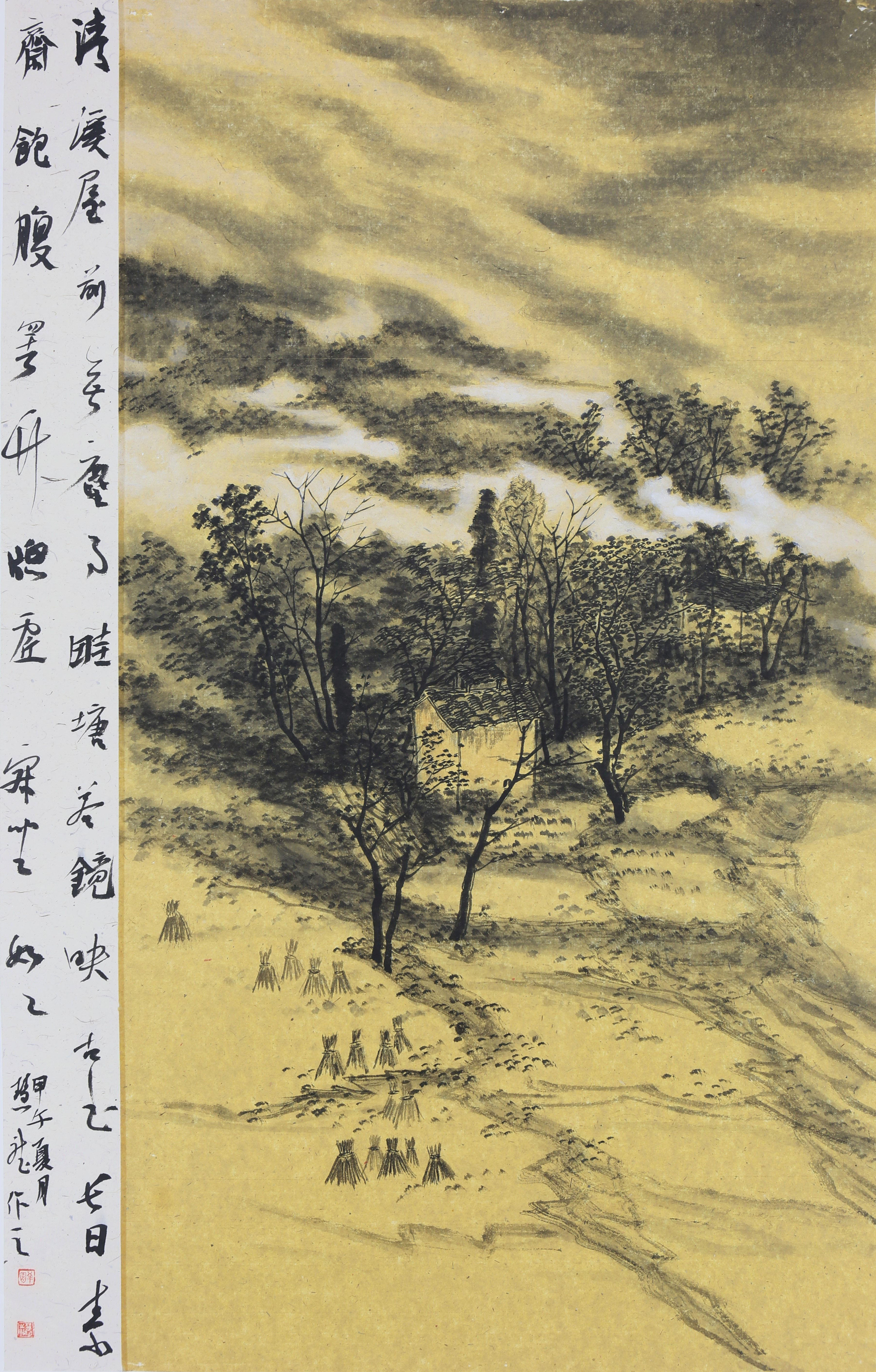
In Silent Sitting (寂坐如如), a modest dwelling stands beside a clear stream, surrounded by trees and peaceful fields. Rather than presenting an imposing or dramatic wilderness, the painting evokes a cultivated retreat—a place where daily life and the natural environment exist in quiet balance.
The poem inscribed on the painting describes a clear stream and a tranquil home, a pond reflecting old books, and the artist sitting peacefully beside a bamboo window after a simple meal. These details suggest an ideal of life in which contentment comes not from material abundance but from freedom from distraction and an attentive relationship with one's surroundings.
The composition's restrained atmosphere reinforces this idea. The dwelling is integrated into the landscape rather than separated from it, while the surrounding vegetation and water establish a sense of shelter and continuity. The painting's quietness is therefore not emptiness in a negative sense. It is a form of fullness created through simplicity.
The title, Silent Sitting, evokes a state of inward composure. The work recalls the literati ideal of stepping away from worldly concerns to cultivate clarity of mind. Its appeal lies in this understated vision of harmony between the individual and nature.
Long River and Bright Moon: Vastness, Light, and Solitude
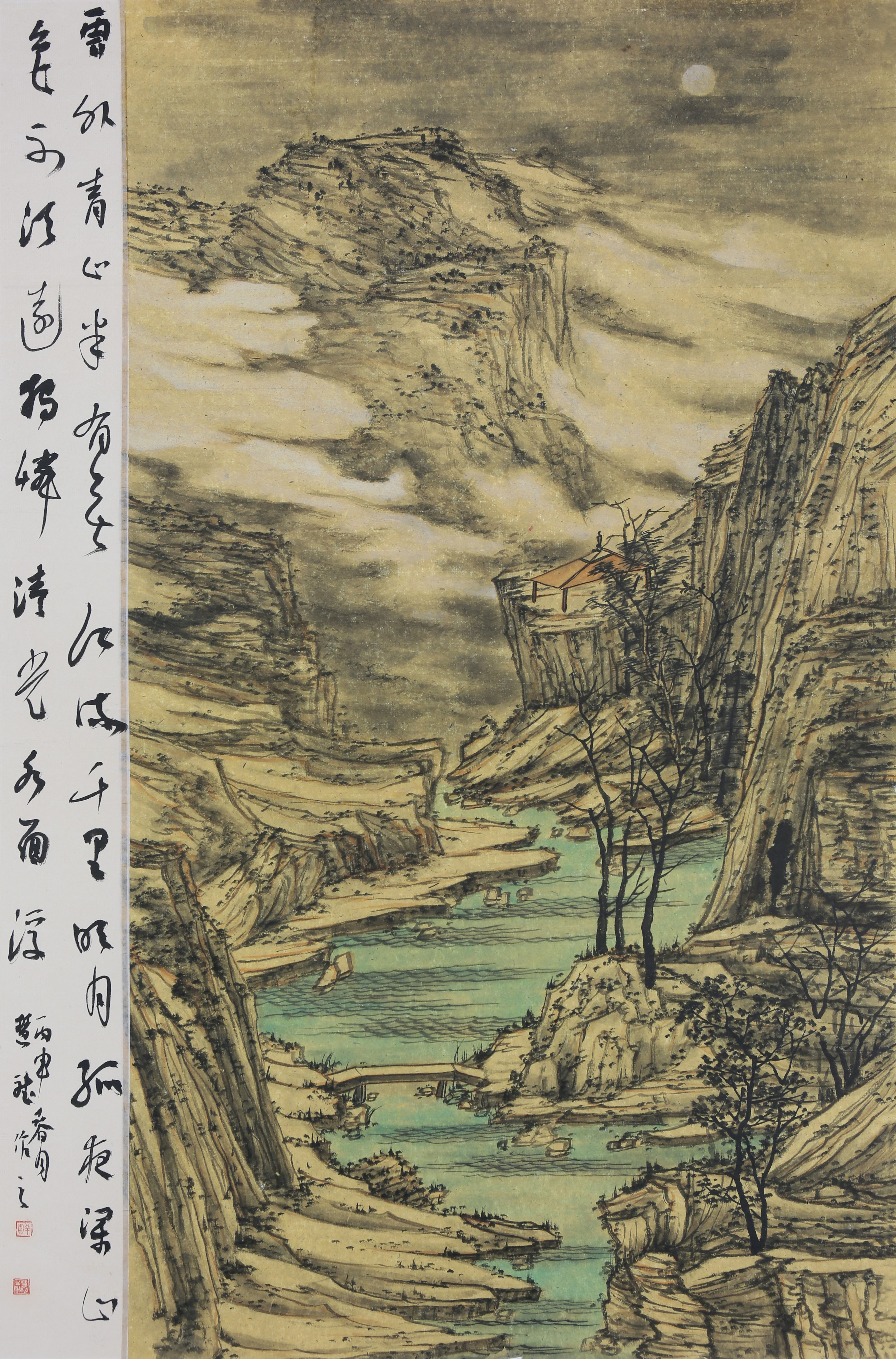
Long River and Bright Moon (江流千里明月孤) expands the viewer's perspective from an intimate retreat to a more expansive landscape. Mountains rise beyond the clouds, while a long river carries the eye into the distance. Above the scene, the solitary moon introduces a point of light within the vastness of the natural world.
The inscription begins with the image of green mountains appearing and disappearing beyond the clouds, followed by a river extending for thousands of miles beneath a solitary bright moon. It concludes with an appreciation of the moonlight reflected on the surface of the water.
The poem and painting work together to create an atmosphere that is both expansive and intimate. The river suggests immense distance, while the reflected light offers a moment of immediate visual pleasure. The landscape thus brings together two seemingly different experiences: the feeling of being small within a vast universe and the intimacy of noticing a delicate change in light.
Moonlight has held a special place in Chinese poetry and painting for centuries. It can suggest solitude, remembrance, distance, and the passage of time. In He Huibin's work, the moon does not dominate the landscape. Instead, it gives the surrounding mountains and water a quiet emotional focus.
The result is a landscape that encourages prolonged viewing. Rather than directing attention toward a single dramatic event, the painting allows the eye to move gradually through its spaces, following the river and discovering the relationships between mountain, cloud, moon, and water.
Autumn Chill, Longing for Chang'an: Landscape and Memory
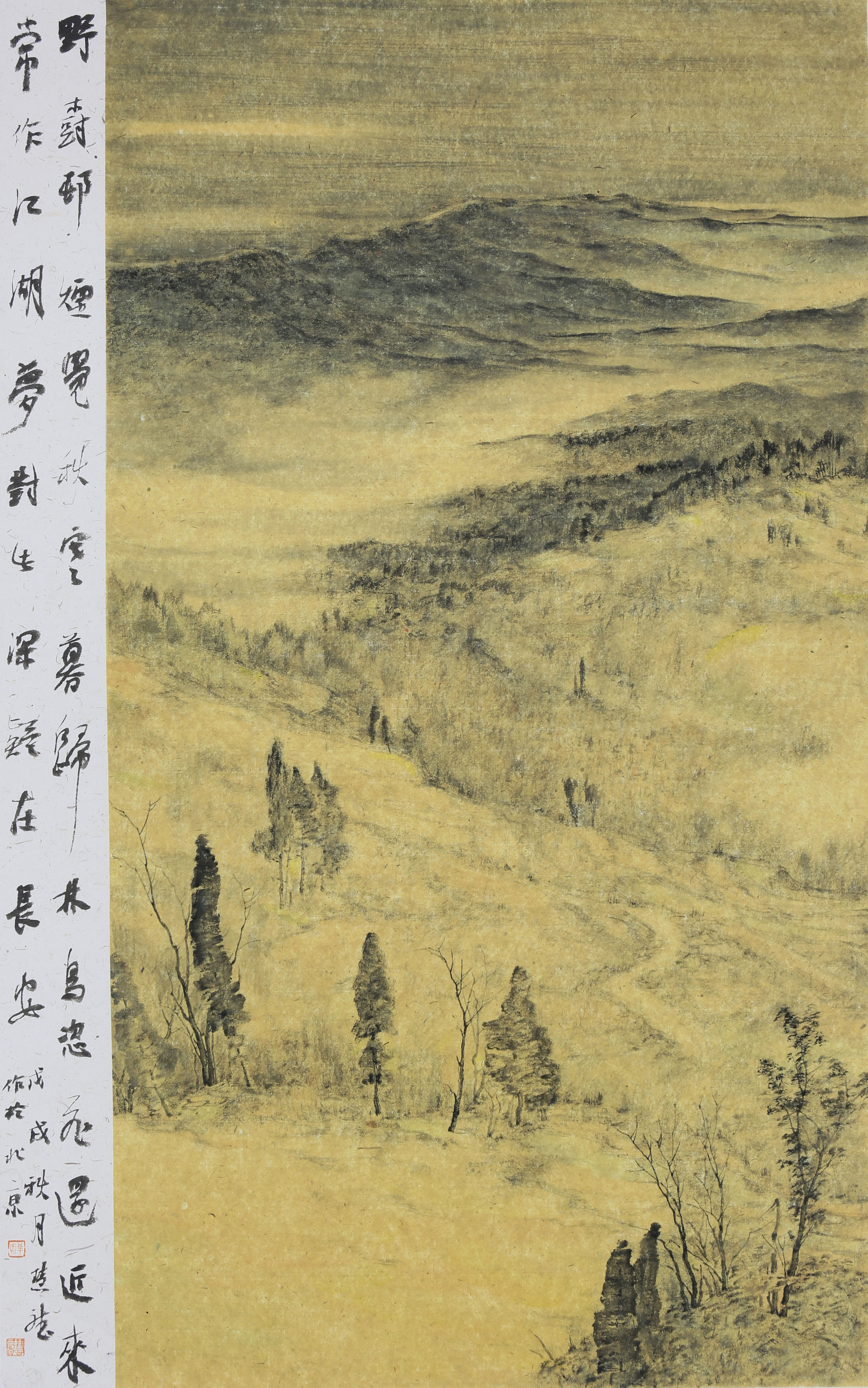
In Autumn Chill, Longing for Chang'an (秋寒憶長安), the landscape takes on a more personal and nostalgic dimension. Autumn trees, distant mountains, drifting mist, and birds returning through the evening air establish a scene of seasonal transition.
The painting's inscription describes the chill of autumn in the countryside, birds flying back toward the woods, and recurring dreams of distant places. The title identifies the emotional center of the work: longing for Chang'an, the historic name of present-day Xi'an, a city deeply embedded in Chinese cultural memory.
In classical Chinese literature, autumn landscapes often carry associations with distance, departure, homesickness, and the awareness of time passing. Changing weather and fading light can transform an ordinary scene into an expression of inner feeling.
Here, the landscape does not illustrate nostalgia in a literal way. Instead, the mountains and trees provide a visual language through which longing can be expressed indirectly. The viewer encounters the emotional atmosphere of remembrance through the relationship between scenery and inscription.
This combination of painting and poetry is central to the work's character. The landscape remains open to individual interpretation, allowing viewers to connect its sense of distance with their own experiences of home, separation, and memory.
Old Mountain in Autumn: The Endurance of Nature
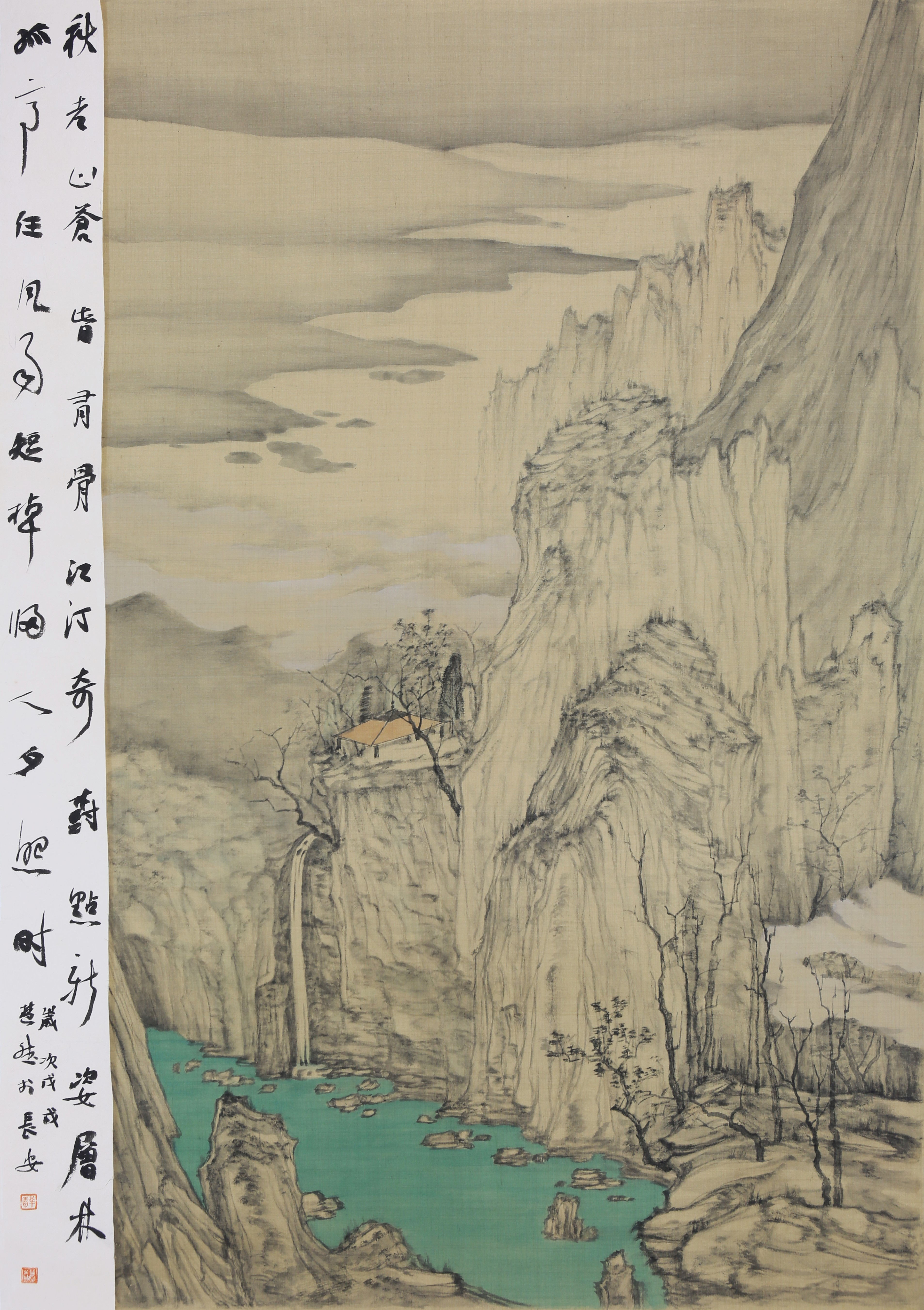
Old Mountain in Autumn (秋老山蒼骨) turns toward the enduring character of the natural world. The mountains appear weathered and substantial, while unusual trees punctuate the riverbanks. A solitary pavilion rests among the distant trees, and a small boat with a returning traveler introduces a subtle human presence.
The inscription describes old autumn mountains whose rugged forms possess a kind of inner strength, unusual trees along the river adding new character to the scene, and a solitary pavilion exposed to wind and rain. The poem concludes with a traveler returning by boat at sunset.
The image of mountains possessing "gu" (骨), or bone, is particularly evocative. In Chinese artistic language, the idea of bone can suggest structure, strength, character, and the underlying vitality of a form. The mountain is therefore more than a geological feature. It becomes an image of endurance shaped by time.
The solitary pavilion and returning traveler introduce a complementary sense of human transience. The traveler passes through the landscape, while the mountains remain. The fading sunlight marks the end of the day, yet the landscape retains its quiet presence.
This relationship between change and permanence gives the painting its reflective quality. Nature is neither entirely untouched by time nor diminished by it. Its weathered forms possess a dignity that emerges precisely through age and endurance.
Poetry, Calligraphy, and the Language of Ink
Across these four paintings, the inscriptions are essential to understanding He Huibin's artistic approach. They do more than identify the subject or record the date of creation. They establish an intellectual and emotional dialogue with the painted scene.
The relationship between poetry and painting has been fundamental to Chinese literati aesthetics. A poem can articulate an emotion that the landscape only suggests, while the painting gives visual form to an idea that words alone cannot fully convey. Calligraphy adds another expressive dimension through the movement, rhythm, and physical character of the written line.
Ink and color likewise contribute to this dialogue. Mountains, trees, and water are shaped not only by their recognizable forms but also by the handling of the brush and the distribution of tonal emphasis. The viewer is invited to appreciate both what is depicted and how the image has been constructed.
Equally important is the space left open within the composition. In Chinese painting, unpainted areas can suggest mist, water, distance, or atmosphere. They also allow the viewer's imagination to participate in completing the scene. What is left unsaid or unpainted may carry as much meaning as what is explicitly shown.
A Contemporary Dialogue with Chinese Landscape Tradition
Although these four paintings draw upon a long-established artistic language, their significance does not depend solely on historical continuity. They also offer contemporary viewers an opportunity to reconsider the value of attentiveness, solitude, and a more measured relationship with the natural world.
Each painting approaches this experience differently. "Silent Sitting" presents the possibility of retreat and inward composure. "Long River and Bright Moon" opens onto the vastness of nature and the intimacy of moonlight. "Autumn Chill, Longing for Chang'an" connects scenery with memory and longing. "Old Mountain in Autumn" reflects on endurance, change, and the passage of time.
Together, they form a varied meditation on the relationship between landscape and human experience. Their mountains and rivers are not merely scenic subjects; they are places where thought, feeling, and visual expression meet.
For collectors and enthusiasts discovering Chinese painting, He Huibin's works offer an accessible introduction to the literati tradition and its continuing relevance. They demonstrate how a landscape can become more than a picture of the external world: it can also be a space for reflection, an expression of memory, and an invitation to see nature with greater patience and sensitivity.
Through these four paintings, SailUp Arts invites viewers to discover the enduring poetry of Chinese landscape painting and the quiet richness that emerges when brushwork, poetry, and nature are brought into harmony.