
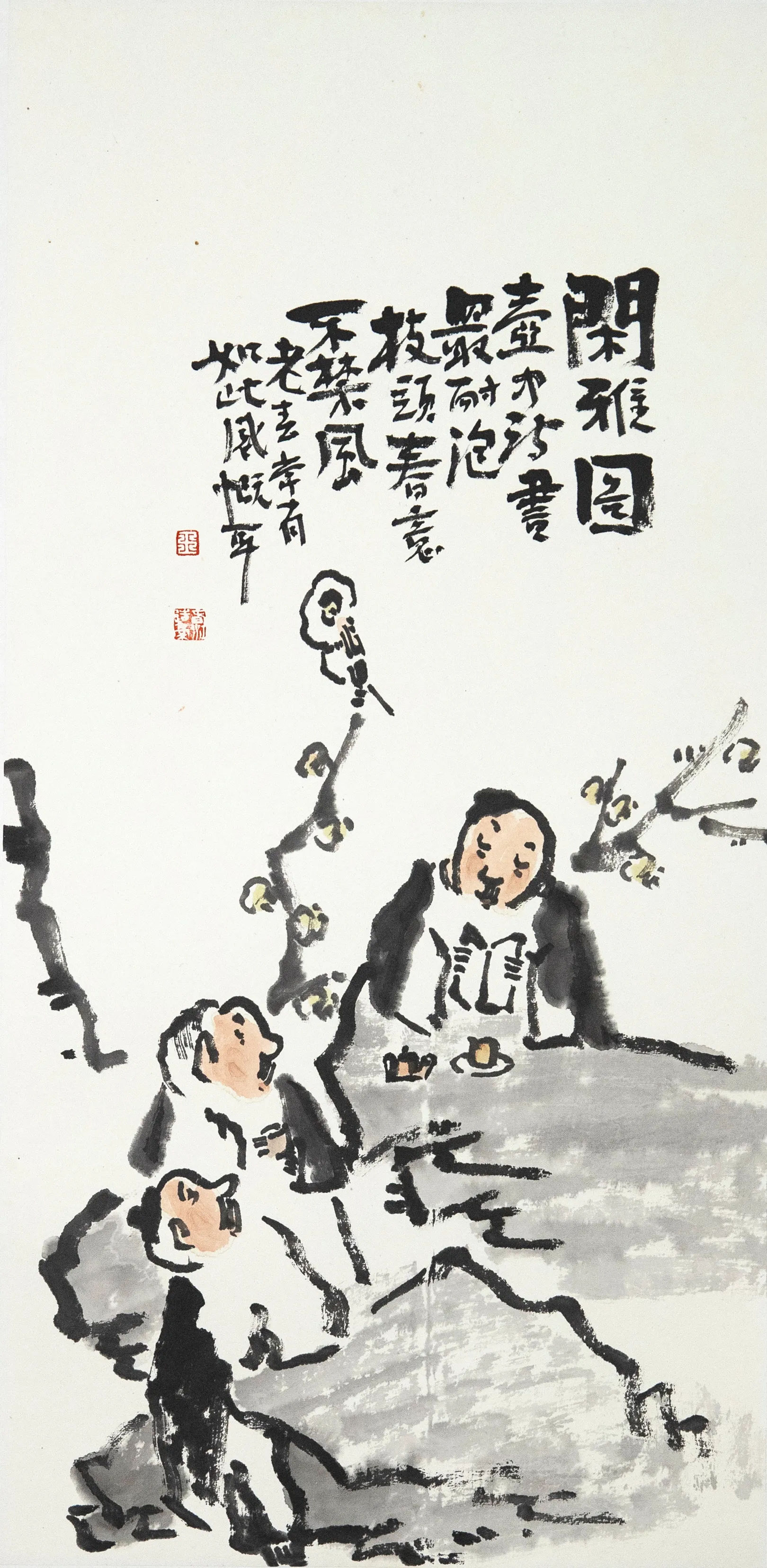
In contemporary Chinese painting, the tradition of the literati has never been simply a matter of reproducing ancient forms. Its deeper spirit lies in the freedom to express personal experience, intellectual reflection, humor, and an attitude toward life. Few contemporary artists embody this spirit as naturally as Wang Chunjiang (王春江).
Born in 1955 in Huantai County, Shandong Province, Wang Chunjiang is regarded as a representative artist of China's New Literati Painting movement. His artistic practice combines figure painting, calligraphy, poetry, and personal observation, while his inscriptions often introduce an unexpected element of humor or self-mockery. Rather than presenting the idealized world of the traditional scholar, Wang's figures inhabit a recognizable human world—one filled with leisure, confusion, friendship, contradiction, and the small absurdities of everyday life.
The eight works presented here, created between 2016 and 2023, offer an especially revealing view of Wang Chunjiang's artistic language. Although their compositions are often remarkably simple, each painting is accompanied by an inscription that expands the image into a meditation on life.
Painting as a Conversation Between Image and Inscription
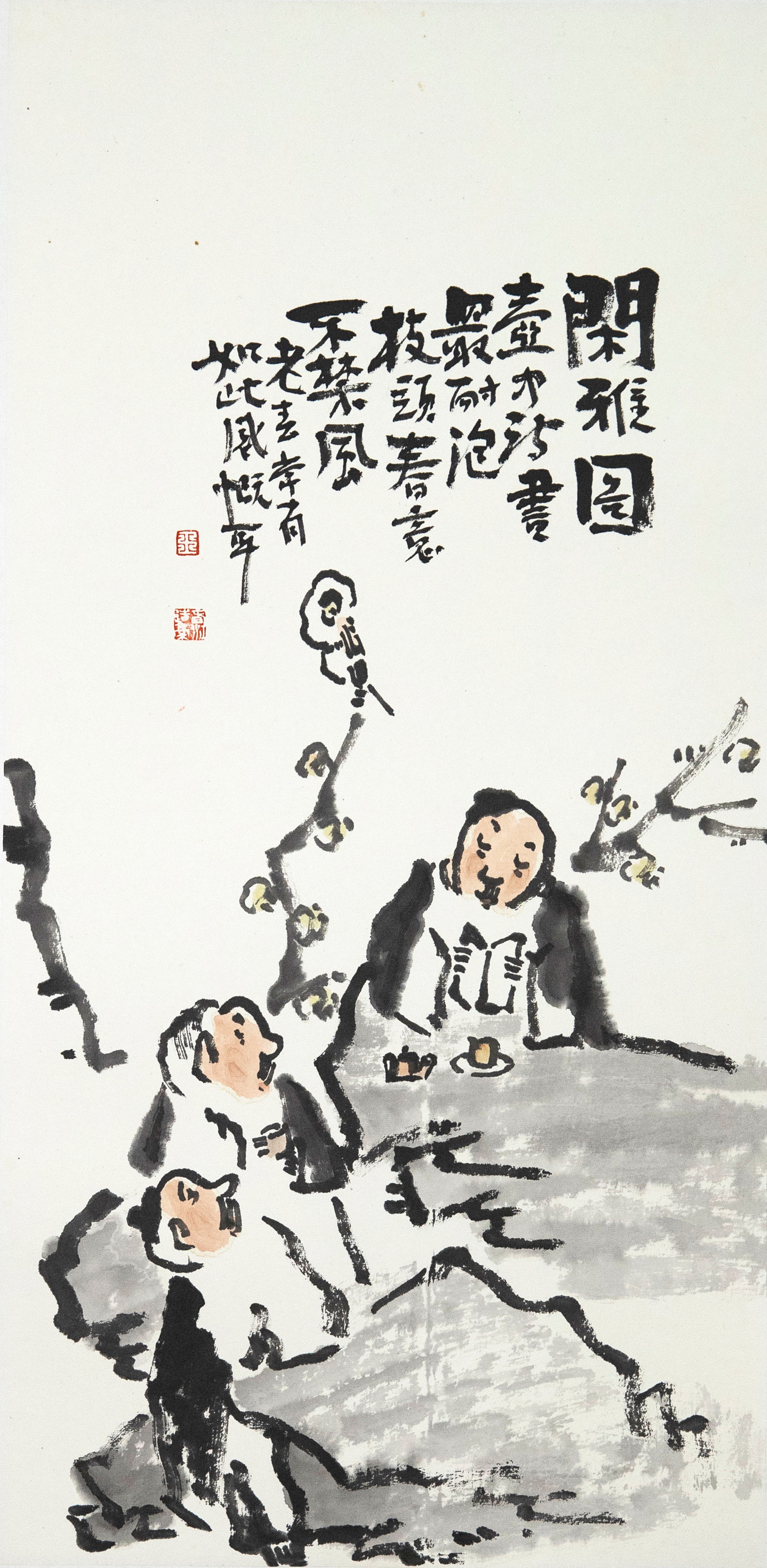
- Leisure and Elegance (閑雅圖), 2023
One of the most distinctive features of Wang Chunjiang's work is the relationship between the painted image and the written word.
In traditional Chinese literati painting, poetry, calligraphy, painting, and seal carving were understood as interconnected forms of expression. Wang inherits this tradition but gives it a distinctly contemporary tone. His inscriptions do not merely identify the subject. They frequently introduce a joke, a paradox, or a personal observation that changes the way the image is understood.
In Leisure and Elegance (閑雅圖), three figures sit together in an atmosphere of relaxed companionship. Tea, books, conversation, and the flowering branch create a world of cultivated leisure. The inscription reads:
“壺中詩書最耐泡,枝頭春意不禁風。”
The image therefore becomes more than a scene of people sitting together. It becomes a reflection on the pleasures of reading, tea, friendship, and the passing of spring. The work embodies the traditional literati ideal of xianya—a cultivated form of elegant leisure—while presenting it with an unmistakably contemporary lightness.
Humor as a Form of Wisdom
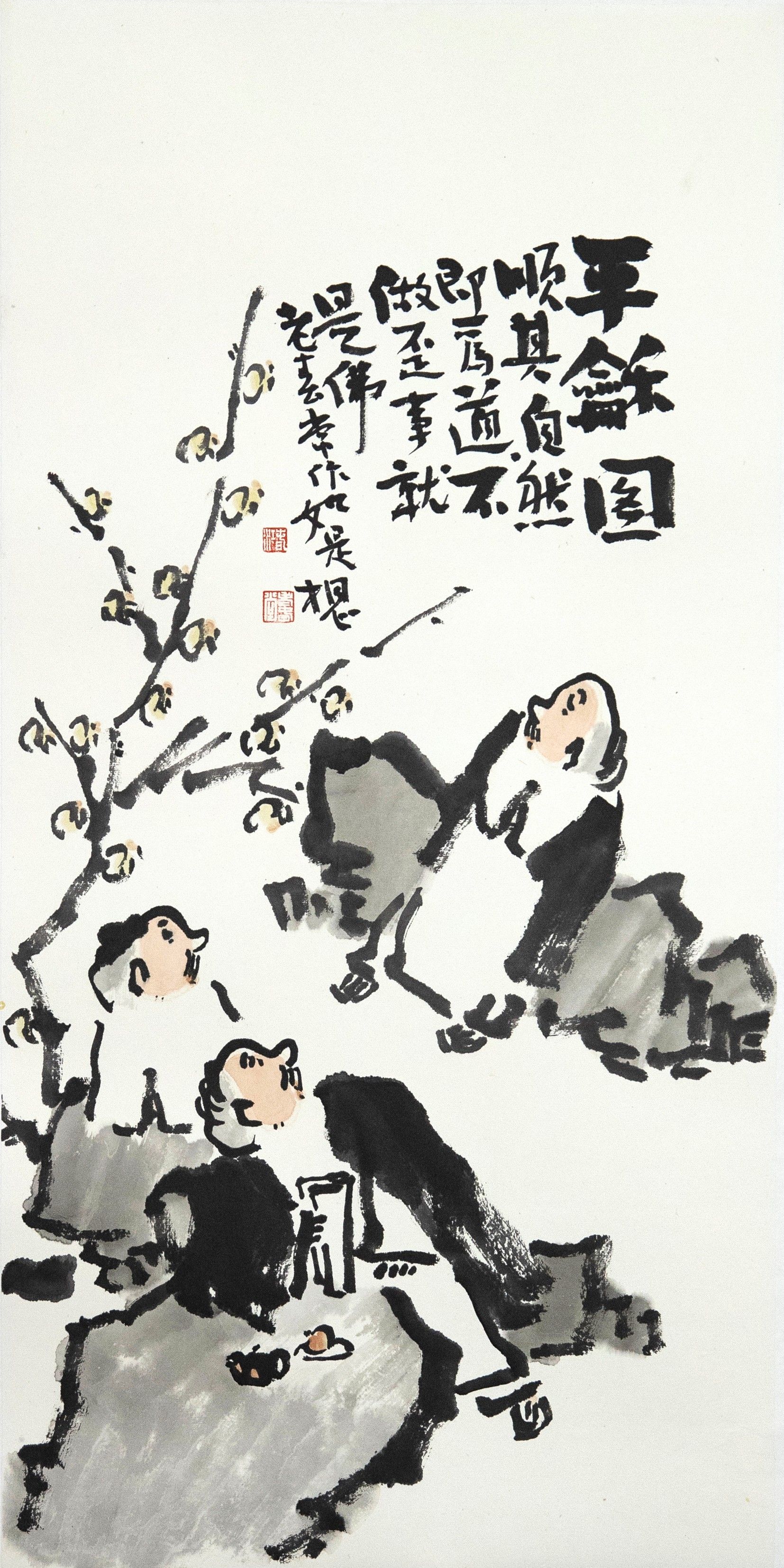
- Peaceful Harmony (平和圖), 2023
Humor is perhaps the most immediately recognizable characteristic of Wang Chunjiang's figure paintings.
Peaceful Harmony (平和圖) presents several figures sitting together in conversation. The composition is deliberately restrained, but the inscription adds another dimension: “順其自然即爲道,不做歪事就是佛.” The seemingly ordinary scene thus becomes a humorous and philosophical reflection on how to live.
This combination of simplicity and philosophical wit appears again in Nurturing Laziness (養懶圖). Two figures rest beneath a flowering tree while birds observe them. The title itself is deliberately provocative. Instead of celebrating ambition and productivity, Wang turns “laziness” into a subject worthy of contemplation.
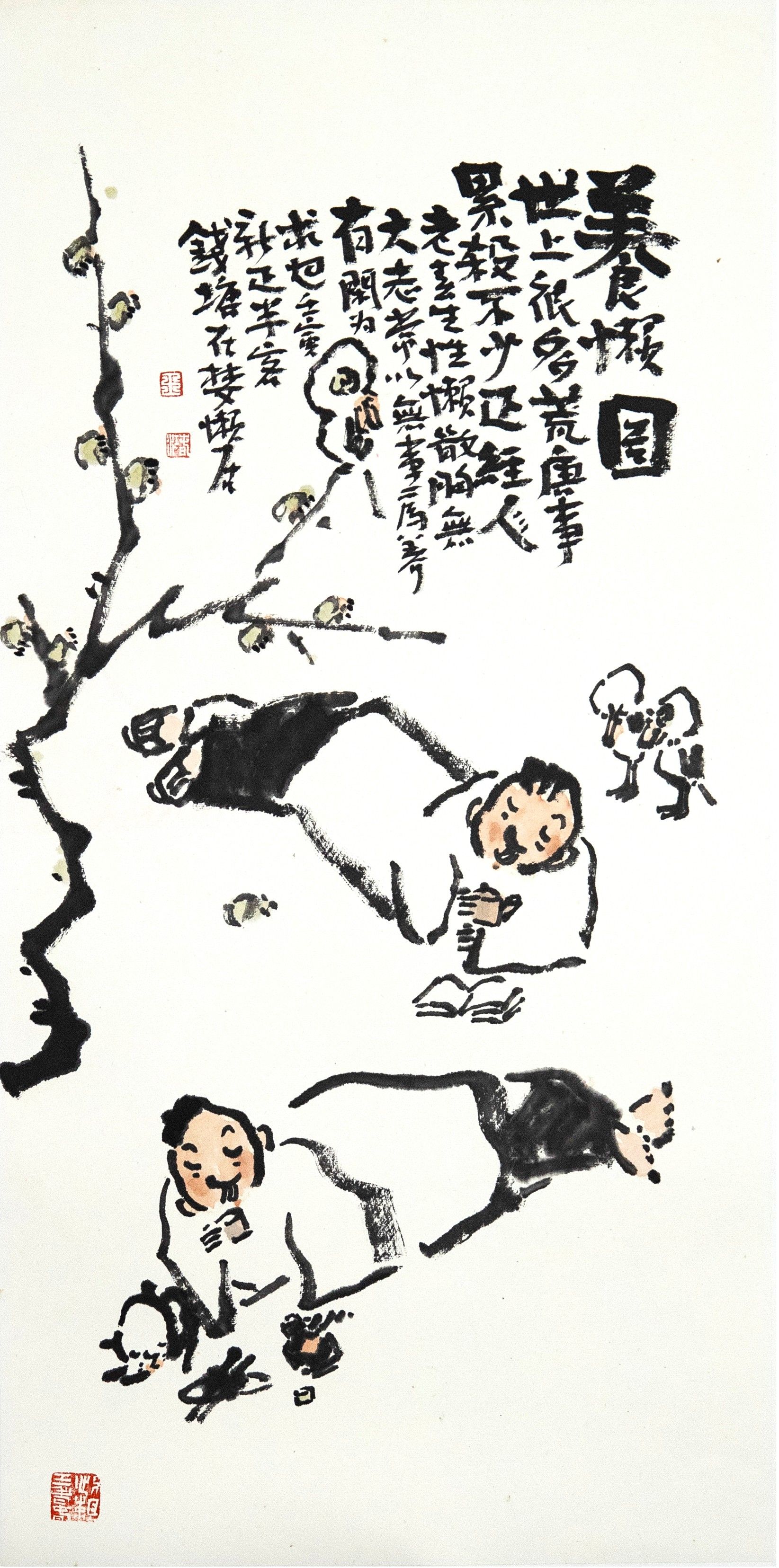
- Nurturing Laziness (養懶圖), 2023
His inscription explains his position with characteristic self-mockery: “世上好多荒唐事,累殺不少正經人.” He describes himself as naturally lazy, without great ambition, and content to regard having nothing to do as a form of cultivation. The joke is obvious, but beneath it lies a serious question: must a meaningful life always be measured by achievement and productivity?
Spring, Friendship, and the Art of Doing Less
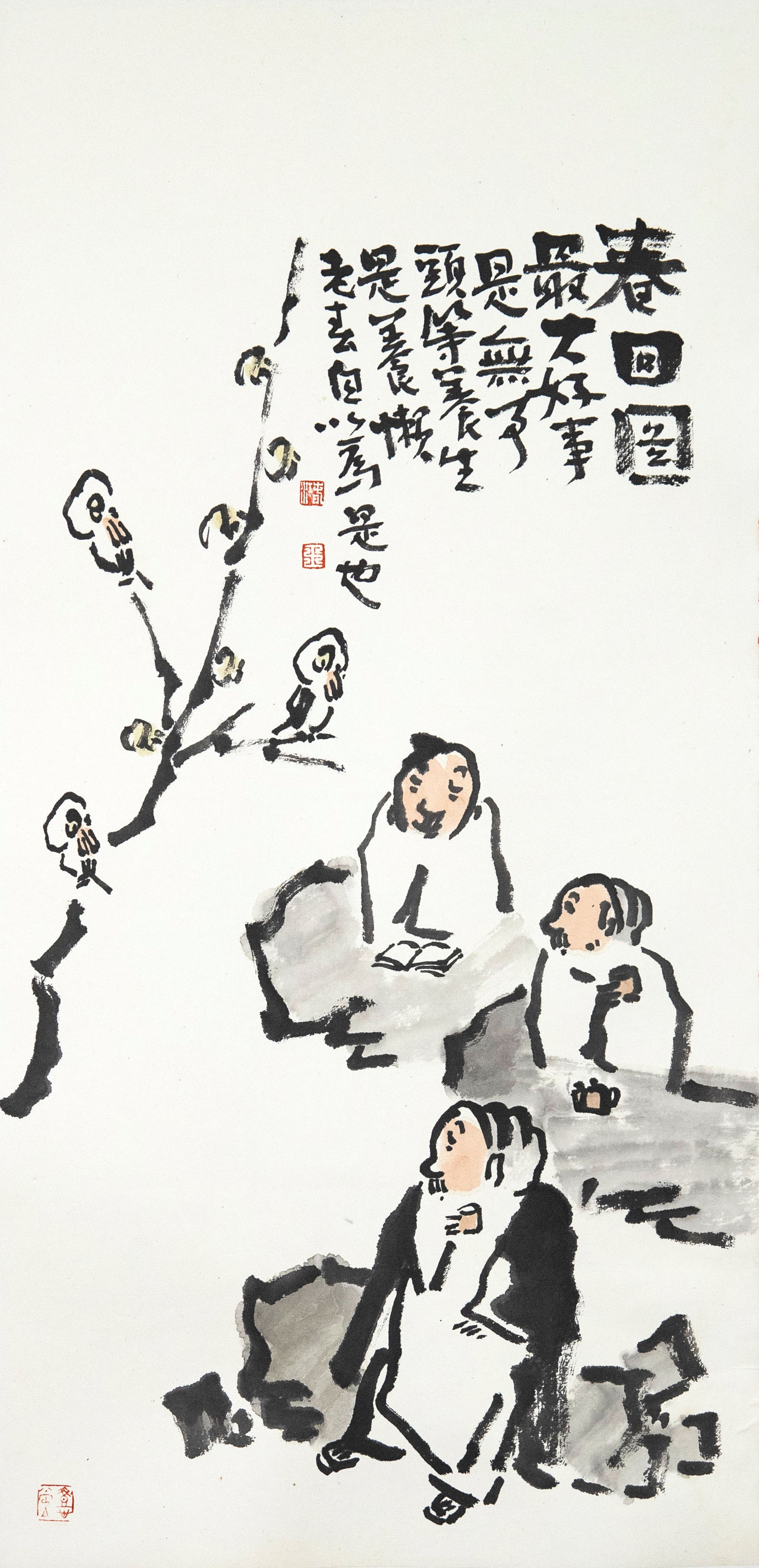
- Spring Returns (春回圖), 2023
The theme of leisure continues in Spring Returns (春回圖), in which three relaxed figures appear alongside a flowering plum branch.
The inscription states: “最大好事是無事,頭等養生是養懶.” The statement is humorous, but it also challenges the contemporary obsession with constant activity. For Wang, rest is not simply inactivity. It can be a form of awareness—a way of recovering one's relationship with time and oneself.
A related sentiment appears in Visiting an Old Friend (訪故圖). Two figures meet beneath a budding plum branch, while the inscription describes the transition from winter to warmth: “寒流寂然去,新暖悄然來.”
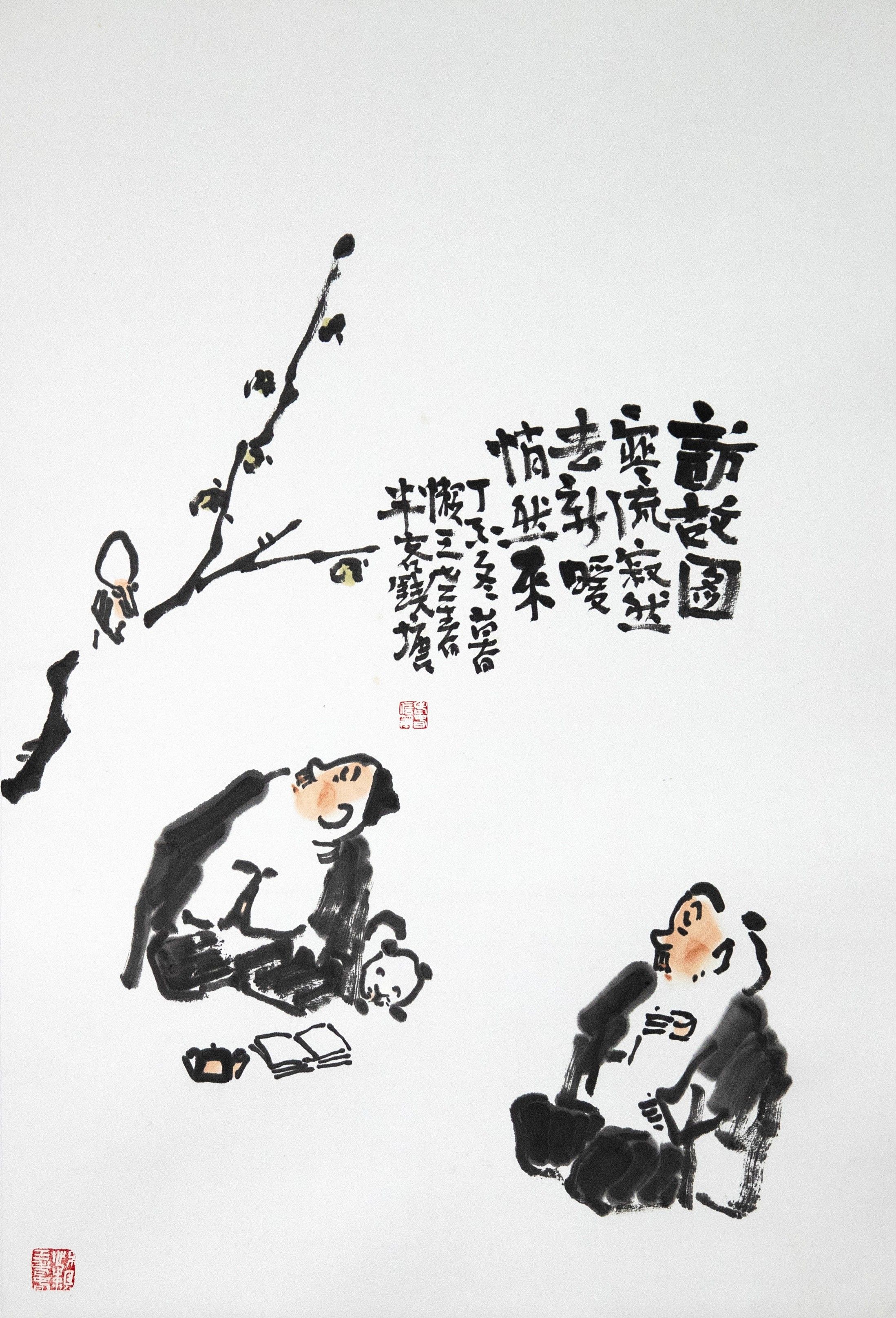
- Visiting an Old Friend (訪故圖), 2017
Here, the subject is not a dramatic event but a quiet human encounter. The arrival of spring becomes a metaphor for friendship and renewal. The understated composition allows the viewer to participate in the silence between the figures, rather than simply observing a narrative.
Beneath the Surface: Human Nature and Contradiction
Wang's humor is not always gentle. At times, it becomes a sharp observation of human nature.
In Pure Elegance (清雅圖), two figures stand beside bamboo. At first glance, the painting appears calm and refined. Yet the inscription introduces a striking contrast:
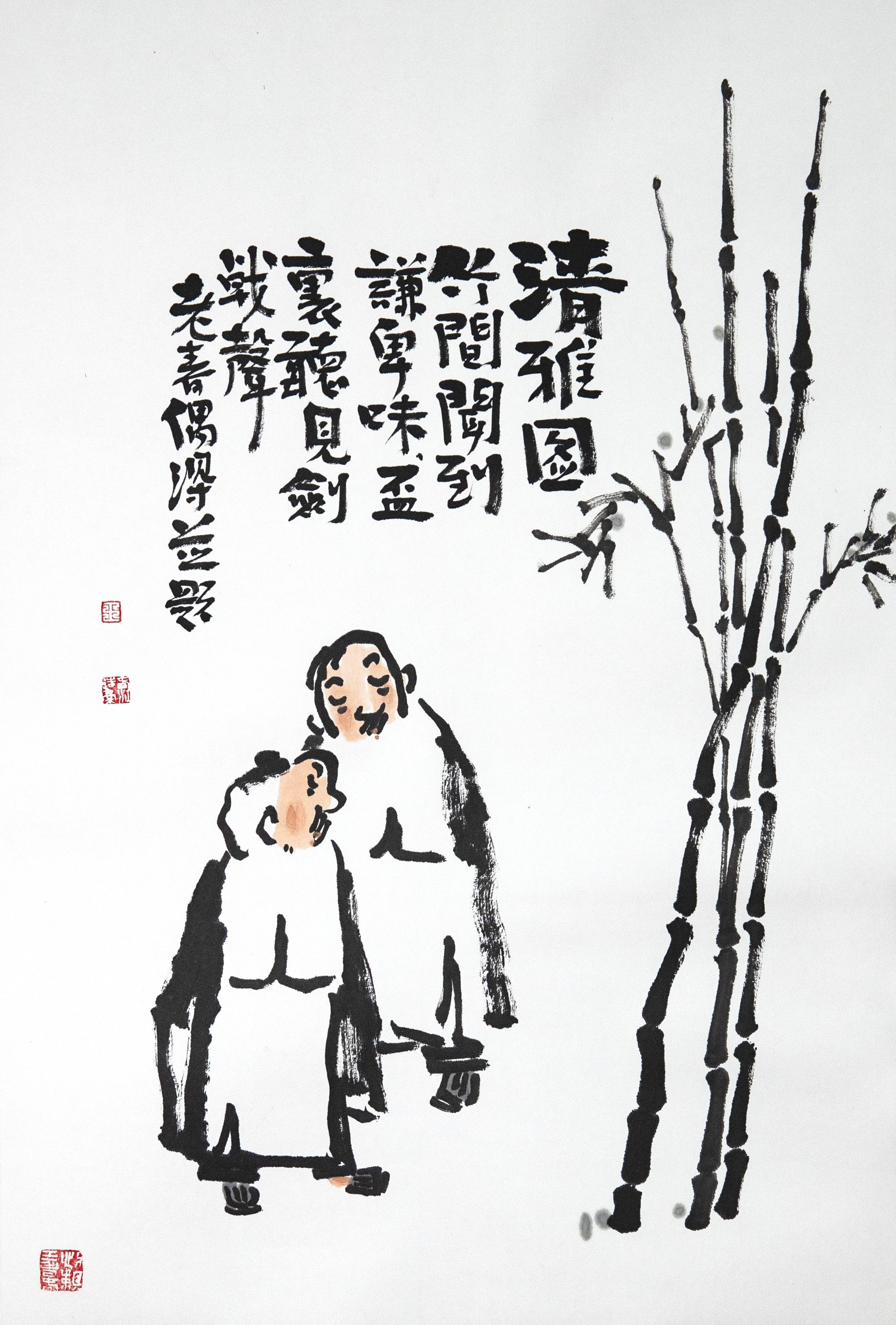
- Pure Elegance (清雅圖), 2022
“竹間聞到謙卑味,懷裏聽見劍戟聲。”
The phrase suggests that an appearance of humility may conceal conflict and aggression. Bamboo traditionally symbolizes integrity, modesty, and moral strength, but Wang complicates that symbolism. Beneath an elegant exterior, human motives may be far more complicated.
This tension between appearance and reality is characteristic of Wang's approach. He uses the visual vocabulary of traditional literati painting but employs it to examine modern human behavior.
The Absurdity of Everyday Life
Questioning the Foolish Gourd (問傻圖) takes this approach even further.
A solitary figure looks toward hanging gourds, while the inscription reflects on money, embarrassment, compromise, and the difficulty of balancing different desires in life. Wang even invokes the contrast between the ordinary person represented by “阿Q” and modern financial success represented by Buffett and Bill Gates.
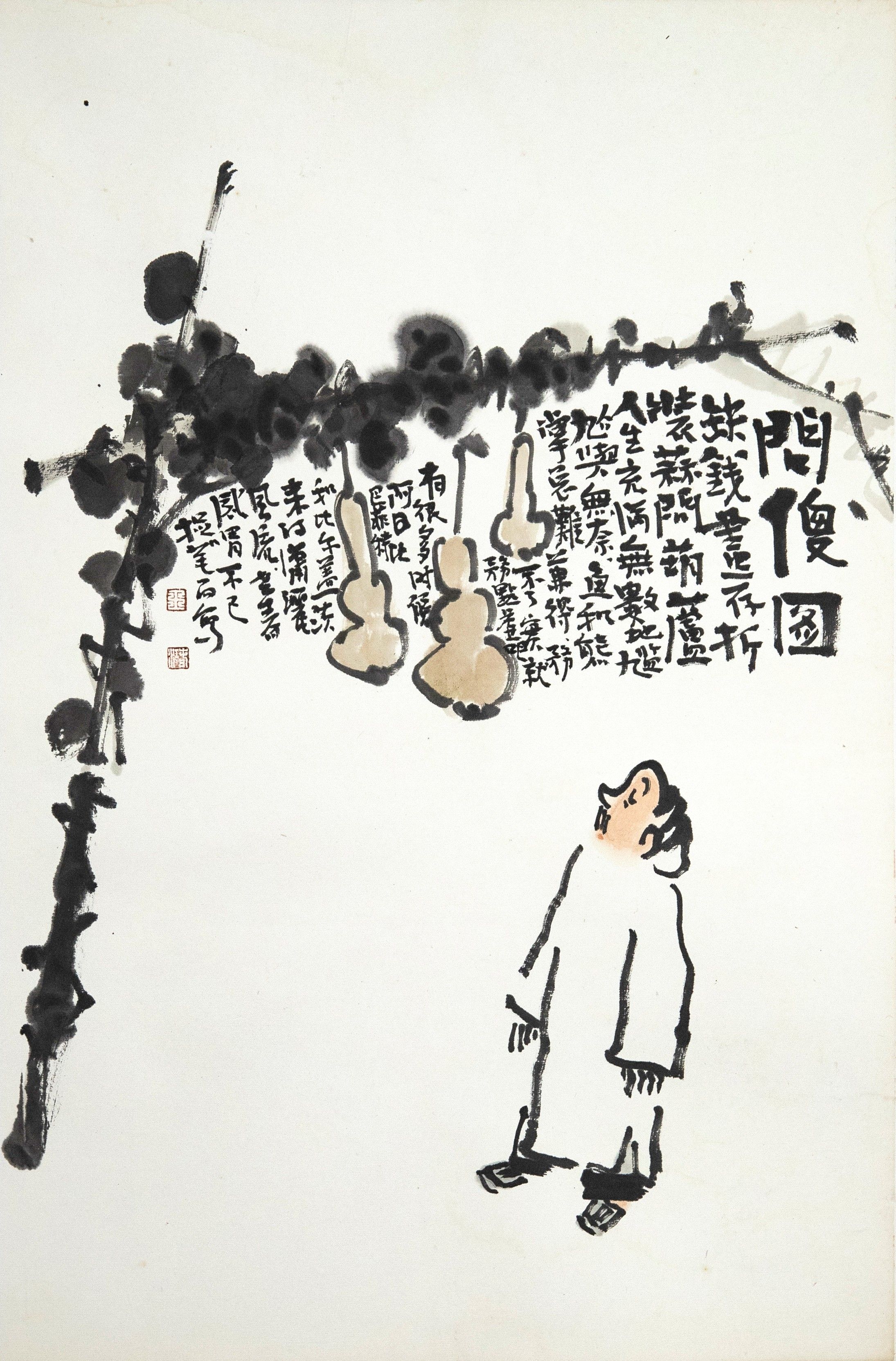
- Questioning the Foolish Gourd (問傻圖), 2016
The humor is deliberately exaggerated. Yet the underlying subject is serious: human beings constantly negotiate between ideals and reality, dignity and necessity, ambition and limitation. The gourd becomes almost a stage prop in a small philosophical comedy about modern life.
“奈何”: The Wisdom of Knowing One's Limits
Perhaps the most introspective work in this group is Helplessness (奈何圖).
A solitary figure sits beneath flowering branches, accompanied by a bird. The inscription reads:
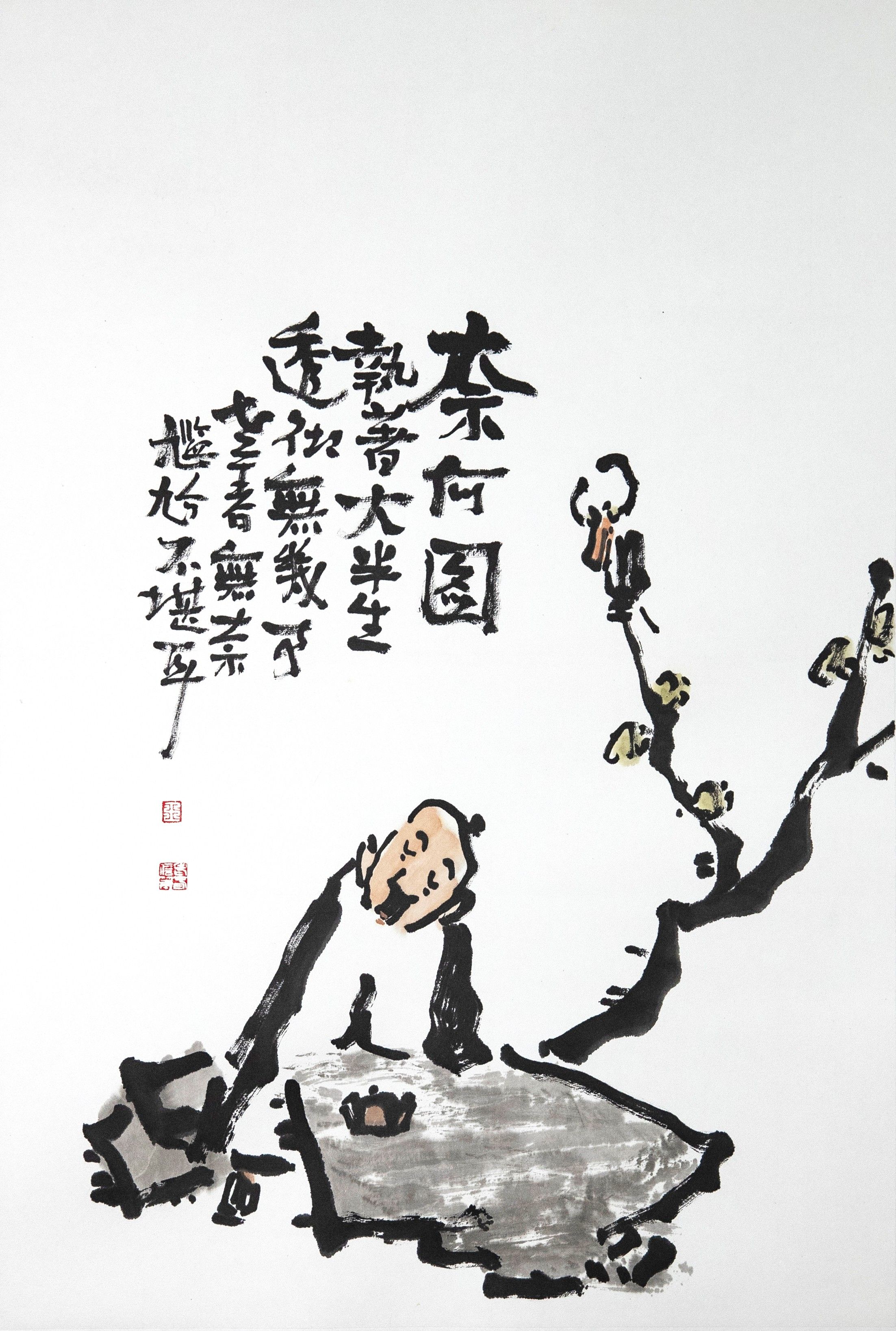
- Helplessness (奈何圖), 2022
“執著大半生,透徹無幾事。”
After a lifetime of persistence, how much have we truly understood?
The simplicity of the image makes the question more powerful. The flowering branch suggests life and renewal, while the seated figure appears absorbed in thought. Wang does not attempt to resolve the contradiction. Instead, he allows uncertainty itself to become the subject.
This is an important aspect of his art: humor ultimately leads to self-reflection. The joke may make the viewer smile, but the smile is often followed by recognition. The situations Wang depicts are funny precisely because they are also familiar.
A Contemporary Form of Literati Painting
Taken together, these eight paintings demonstrate that Wang Chunjiang's New Literati Painting is not simply a revival of an old aesthetic style.
He retains the essential elements of the literati tradition—ink, expressive brushwork, poetry, calligraphy, seals, cultivated leisure, and the close relationship between painting and personal thought. Yet he replaces the conventional image of the lofty scholar with ordinary people confronting very ordinary problems: how to spend one's time, how to deal with money, how to maintain friendships, how to understand human nature, and how to accept the limitations of one's own life.
This is where Wang's work becomes distinctly contemporary.
His figures may sit beneath plum blossoms, beside bamboo, or around a tea table, but their concerns belong equally to the present day. His language is classical in form yet modern in attitude. His humor prevents the paintings from becoming overly solemn, while his inscriptions give apparently simple scenes intellectual depth.
Most importantly, Wang Chunjiang's paintings suggest that wisdom does not always arrive through grand statements. Sometimes it appears in a joke, a moment of idleness, a conversation between friends, or a quiet figure sitting beneath a flowering branch.
In this sense, his art continues one of the most enduring ideas of Chinese literati painting: painting is not merely a representation of the world, but a way of understanding how to live in it.